The Rainy Port at the End of the Line: A Car-Free Day Trip to Keelung
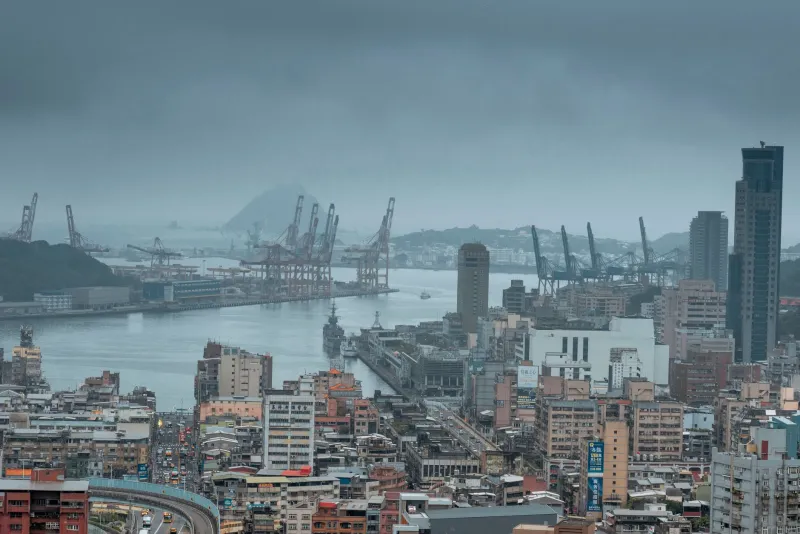
The train pulls out of Taipei Main Station heading north, slips under the river, and within twenty minutes the apartment towers start thinning out. By the time the harbor appears on your left — cranes, container ships, a green hill with a giant white statue on top — you are somewhere else entirely. Keelung has been Taiwan's northern port for more than a century, and it still feels like a working city that happens to be gorgeous, rather than a place built for visitors.
Which is exactly why it makes such a good day trip.
Why Keelung, and why the train
Most travelers treat Keelung as a footnote — the cruise port, the rainy stop on the way to the coast. That is a mistake. This is a city where a 19th-century fort sits above a harbor food market, where a temple is wedged into a hillside, and where the local specialty is a thick crab soup that costs about three US dollars.
The train is the way in. There is no high-speed rail here; you want the regular Taiwan Railways Administration (TRA) service, which is cheap, frequent, and covered by your EasyCard. Trains leave Taipei Main roughly every 20 to 30 minutes throughout the day, and the ride takes about 45 minutes. Just tap in at the gate and tap out at Keelung — no reservation, no seat assignment, no stress. Grab a window on the left side for the harbor approach.
The walking route: harbor, temple, hilltop
Keelung station puts you about two blocks from the water. The route below is a loop of roughly four miles if you do all of it, and it works in either direction.
Start at the harbor plaza, where the city gathers in the evening to watch the port light up. Walk east along the waterfront toward the old downtown, then duck inland to Dianji Temple, a colorful Taoist shrine that sits literally inside the night market — its front steps are where half the food stalls set up. The smoke from the incense burner drifts straight over the crab soup line, and nobody finds this strange.
From there, climb to Keelung Tower, a viewing platform with an elevator that saves your legs and gives you the whole harbor in one frame. Continue up to Ershawan Fort, a mossy coastal defense works from the 1840s with cannons still pointed at the sea, then loop through Zhongzheng Park to the enormous white Guanyin statue that watches over the port. The walk up is shaded, quiet, and studded with stray cats.
Miaokou Night Market: what to order
Miaokou is the reason many Taipei residents get on the train at all. It is not a nighttime-only market — stalls fire up around midday and keep going past midnight — and it is organized by dish rather than by gimmick. Find a seat at a communal table, order from two or three stalls, and share.
The essentials:
- Crab thick soup. The signature bowl: shredded crab in a glossy, vinegar-sharpened stock, thickened just enough to coat a spoon.
- Ding bian cuo. Wide, slippery rice-noodle sheets in a savory soup with mushrooms and shrimp — Keelung's other famous bowl.
- Tempura. Keelung-style fish paste cakes, fried fresh, nothing like the frozen version you know.
- Nutritious sandwich. A deep-fried bun stuffed with ham, egg, cucumber, and mayo. The name is a century-old joke; the sandwich is real and very good.
- Eel noodles or pork rib soup if you want a second bowl and a change of pace.
Cash only, small bills, and expect to queue. Seats are shared, so sit down wherever there is a gap.
If you have extra hours
Hop a local train one stop further to Badouzi, or take a short bus ride to Zhengbin Fishing Port, where the buildings along the water are painted in candy colors and the fish market sells whatever came in that morning. Heping Island Park nearby has a rocky coastline and a seawater pool, and the national marine science museum is a solid rainy-day backup.
Practical notes before you go
Keelung is famously one of the wettest cities in the region. Locals do not carry umbrellas so much as wear rain jackets. Bring one, plus shoes that can take a puddle.
Return trains run until around midnight, so a 9:30 a.m. departure and an 8:30 p.m. return gives you a full, unhurried day. Tap your EasyCard both ways and you will spend less on transport than on lunch.
Finally, check the weather for the coast rather than for Taipei. The two cities are 15 miles apart and frequently have completely different skies — which is half the fun of getting on the train in the first place.