The Point-and-Nod Method: A First-Timer's Script for Taipei Night Markets
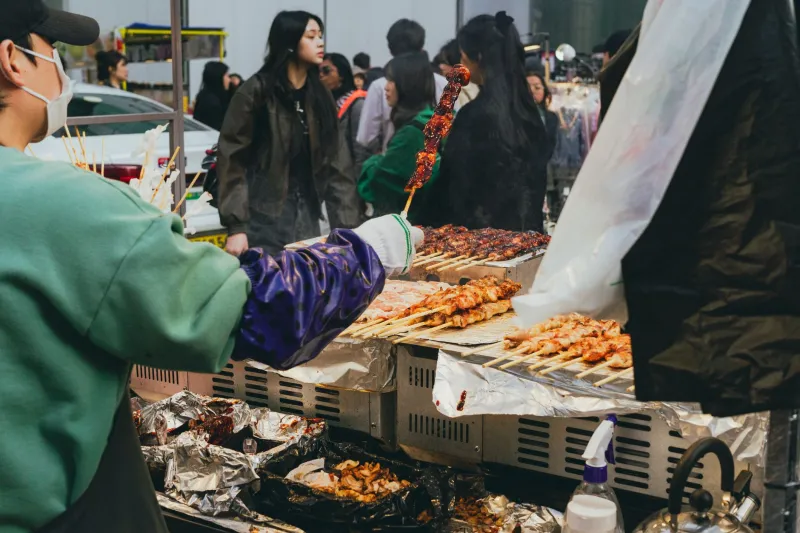
Night market anxiety is real, and it usually peaks in the same three seconds: you reach the front of a stall, twelve people are behind you, and the vendor looks up.
Take a breath. Taipei's vendors have fed millions of visitors who share zero words of Mandarin with them, and the whole system runs on pointing, nodding, and small bills. You just need the moves in advance. Here's the script.
Read the stall before you join the line
Stand back for thirty seconds and answer three questions.
Is there a price list? Numbered signs or a board with NT$ figures mean the stall is used to strangers. No prices at all usually means a neighborhood spot where everyone already knows what a bowl costs — still fine, just budget NT$100 and ask.
Do you pay first or after? Look for a small counter at the front with a cash box and a person taking money. If the vendor hands you a paper ticket, you're in a pay-first stall: hand the ticket to the cook and step aside. If there's no cashier in front, order, eat, then settle up on the way out.
Is there a photo menu? Plenty of carts tape a laminated photo menu to the side, Chinese with English underneath. If you see one, your job just got easy: point at the picture, hold up one finger.
Five phrases that do all the work
You don't need tones. You need four words and a finger. The characters are here so you can show your phone screen, which is a completely legitimate move.
| What you want | Characters | Rough sound |
|---|---|---|
| Hello / excuse me | 你好 | nee how |
| This one | 這個 | juh-guh |
| How much? | 多少錢 | dwaw-shau chyen |
| One, please | 一個 | ee-guh |
| Thank you | 謝謝 | shyeh-shyeh |
Add 不要辣 (boo yow lah) if you want no chili, and 不要太辣 for mild. Ordering a drink? 少冰 (shaw bing) means less ice — useful, because Taiwanese vendors default to a heroic amount of it.
The point-and-nod, in motion
The full transaction looks like this:
- Catch the vendor's eye and hold up your index finger — the universal signal for one person — while pointing at the item or the photo.
- Two fingers for two portions. In Taiwan, hand-counting runs one through five on one hand; six and up gets creative (six is thumb and pinky extended, like a shaka).
- If they fire a question at you fast — spicy? to go? — the safe answer is 好 (how), meaning 'sure,' or 內用 (nay-yong) if you want to eat in. If you truly don't follow, smile and say 都可以 (doh keh-yi): 'whatever's normal.'
- Pay with cash. Small bills. Nothing slows a line like a NT$1,000 note for a NT$60 snack.
Most snacks run NT$50–100, so call it two to three US dollars a stop. Carry a few hundred in fives and tens and you'll never fumble. A growing number of stalls take EasyCard or a QR payment, but assume cash and you'll never be stuck.
The queue is not a suggestion
In Taipei, a line is sacred. It forms on one side of the stall, it stays single-file even when it doesn't look like it, and the person who 'just wants to ask something' at the front is the villain of the evening. Join the back. Wait. If you need to know what something is, ask the person next to you in line — neighbors are usually delighted to explain, and half the time they'll order it for you.
Two more line rules: don't block the sidewalk while you decide, and step aside immediately after ordering at a pay-first stall. The counter is for transactions, not for standing.
Seating and the surrender rule
Sit-down areas are shared. At a stall with stools and folding tables, you take whatever's open, and you may well end up shoulder-to-shoulder with strangers — that's the point. Bag on your lap, not on the empty seat beside you.
The surrender rule: when you finish, leave. Don't linger over a photo edit while a family of four circles the table. Eating something from a different stall is fine at most open seating areas; at a stall with its own dedicated tables, do them the courtesy of ordering a drink.
Tissues are your napkin, your plate wipe, and your stand-in for a wet wipe. Every table has a pack. Use them.
Build the three-market route
Don't do all three in one night — you'll be full by stall four and grumpy by stall six. Spread them across three evenings, one market per night, and walk in hungry.
Night one: Ningxia (near Shuanglian MRT)
Compact, dense, easy to lap twice. Start with chicken rice — shredded chicken over rice for less than a coffee back home — then an oyster omelet, then a peanut ice cream wrap for dessert. This is the friendliest market for a first-timer: short lines, tight layout, lots of photo menus.
Night two: Raohe (near Songshan MRT)
Enter under the ornate gate on Raohe Street and follow the smell of Fuzhou pepper buns baking against the wall of the cylinder oven. Get one, burn your mouth, get another. Then pork-rib herbal soup, grilled squid, and mochi. Raohe is a single long street, so you can't get lost — you'll just drift downhill through it.
Night three: Shilin (near Jiantan MRT)
The big one, and the most touristy, which also means the most English. Go for the fried chicken cutlet the size of your face, sausage stuffed inside sausage, and shaved ice to finish. Skip anything you can get at home and join whichever stall has the longest local line.
Carry these five rules home
Cash in small bills. One finger means one. Pay where the cash box is. Never cut the line. Leave the stool when you're done.
Do that and by night three you'll be the one explaining the pepper bun to a nervous newcomer — which is exactly how it should go.