Fold by Fold: A Beginner's Decision Tree for Taipei's Dumplings
For a city that's famous for dumplings, Taipei can be surprisingly confusing on arrival. You sit down, the menu is a grid of characters, and every table around you is eating something that looks related but isn't quite the same thing. Thin skins, thick buns, soup inside, soup outside, fried on one side, boiled in a bowl.
Here's the good news: they're all made of roughly the same three ingredients and differ mainly in engineering. Once you can tell them apart, ordering stops being stressful and starts being fun. Think of the below as a decision tree — answer three questions, land on a dumpling.
Ask yourself three questions first
How hungry am I? A steamer of soup dumplings is a snack. A plate of boiled dumplings is a meal.
How much broth am I willing to wear? Some of these leak by design.
How long will I wait? The famous spots can eat an hour of your afternoon. The neighborhood shops usually can't.
Answer those and you're most of the way there.
The five you'll actually meet
Xiaolongbao — the show-off
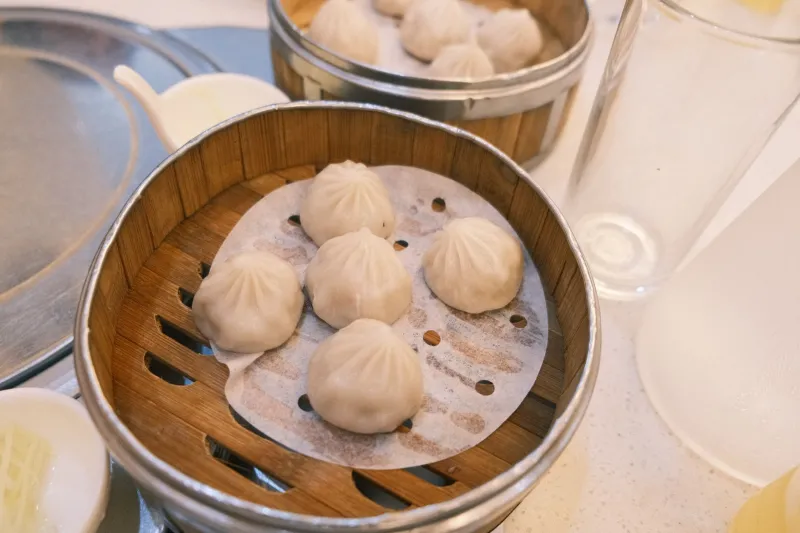
Pleated, golf-ball sized, steamed in a bamboo basket, and containing a small pool of hot broth that exists to scald the impatient. Skin is thin enough to see through; the top twists into eighteen or so little folds. This is the one your friend told you about.
Order by the basket (yi long), usually eight to ten pieces. Pork is the default; shrimp and crab versions exist and cost more. Eat it properly: lift with the spoon, set it down, nip a hole in the side, sip the broth, then finish it. Add slivers of ginger and a splash of black vinegar, but skip drowning it in soy sauce — the kitchen already seasoned it.
Where to try it: Xinyi and Yongkang Street draw the crowds and the queues. The original Din Tai Fung branch on Xinyi Road is the classic first stop, though any of the city's department-store branches will do the same dumpling with a shorter wait.
Guotie — the flat-bottomed workhorse
Potstickers, essentially, and the cheapest way into the family. Elongated, pan-fried on one side only, so you get a crisp brown lid and a soft, pale top. No broth inside, so nothing to spill, nothing to strategize. Order a plate of ten for pocket change and you have a perfectly good light lunch.
Where to try it: Nanjichang Night Market has a long-standing reputation for both guotie and its cousin, boiled dumplings. Any neighborhood breakfast shop will also sell them.
Shengjianbao — the dangerous one
Same pan-fried treatment as guotie, but round, thick-skinned, and full of juice. These are bigger than xiaolongbao and much heavier, with a sprinkling of sesame seeds and scallions on top. The texture is breadier, more like a bun, and the filling is genuinely hot — this is the dumpling that has ruined the roof of many a confident mouth.
Where to try it: Wanhua, around Longshan Temple, is thick with morning and lunch spots selling shengjianbao by the piece. Buy three, not ten, on your first attempt.
Wonton — the soup one
Thin, floppy skins wrapped loosely around pork, served in a clear broth with a little greens and maybe some dried seaweed. Mild, gentle, and about as non-intimidating as dumplings get. If you've just landed, if you're traveling with a picky eater, or if it's 11 p.m. and you need something warm and simple, this is your answer.
Where to try it: almost everywhere, but the small shops near Shida Night Market and the alleys off Raohe do a good version. Order yi wan tang — one bowl of soup.
Chaoshou — the chili-oil one
The Sichuan cousin. Wonton-adjacent, but instead of a clear broth it arrives sitting in red chili oil, often with a slick of garlic and vinegar and a scatter of crushed peanuts. Spicy in a slow, building way rather than a punch. Order it with a side of plain rice or a cold vegetable dish to keep things balanced, and ask for xiao la (mild) if you're nervous.
Where to try it: any restaurant that leans Sichuan — they're all over the Daan and Zhongshan areas.
Bonus: shuijiao — plain boiled dumplings, plump and pleated, served on a plate rather than in soup. The most meal-like option and the best value for a hungry group.
The decision tree, condensed
- First night, low energy: wonton soup.
- You want the photo and the story: xiaolongbao.
- Under NT$100 and in a hurry: guotie.
- Actually hungry: a plate of shuijiao plus a small soup.
- You like heat: chaoshou.
- You like crunch and don't mind a mess: shengjianbao.
What to say at the counter
You don't need much Mandarin, but a few phrases smooth everything out. Numbers are the key: yi (one), liang (two), san (three). Point at the menu and say a number. For a basket of soup dumplings, yi long is the unit. For pork filling, neiyong; shrimp, xiaren; beef, niurou.
Many smaller shops hand you a paper slip and a pencil. Tick, hand it in, pay at the front, and sit wherever you're waved. Bigger restaurants use a queue ticket — take one, stand outside, and watch the number board.
Cash still rules in the small spots. Tipping isn't a thing. Sharing a table with strangers at peak hours is normal and not rude.
Two etiquette notes that matter
Don't order four steamers on your first visit. Start with two items, finish them, and order again if you're still hungry — the food arrives fast and the table is small.
And give the soup dumpling thirty seconds. The broth inside is hotter than the outside suggests, and the correct method (spoon, hole, sip) exists for a reason. Everyone burns themselves once. Try not to be everyone.
A short eating route if you want one
Start with guotie at a morning stall in Wanhua, walk it off at Longshan Temple, ride the MRT to Yongkang for a midday basket of xiaolongbao, take an afternoon break, then finish with chaoshou and a cold beer in the evening. Four styles, one day, no queues longer than you can stand.
That's the whole family. Everything else is a variation on a fold.