Party of One, Zero Awkwardness: A Taipei Solo-Dining Field Guide
In plenty of US cities, walking into a restaurant alone at dinner can feel like a small confession. The host glances at the empty space behind you, asks if you're waiting for someone, and then seats you at the bar like it's a consolation prize. Taipei does not do this. The city's eating infrastructure quietly assumes that one person still needs lunch, dinner, and a stool to sit on. That is the real solo-dining advantage here: it isn't a special accommodation. It's the default setting.
The Seat Is the Invitation
Look at how Taipei eats. Beef noodle shops run on narrow counters facing the kitchen. Dumpling places have small tables that fit two, not six. Night-market stalls bolt stools to the pavement and expect a steady rotation. Even hot pot, that most communal of meals, has been engineered into a single burner with a small pot and a divider so you can cook your own lunch without recruiting a group chat.
This changes the social math. You do not need to explain yourself. You do not need to order extra food to justify the table. You can walk in, point at a stool, and eat. In Taipei, the phrase table for one is not a request for special handling. It is just a description of what is about to happen.
Three Formats That Work Best
Counter noodle shops
These are the workhorses of solo eating. Look for a storefront with a short menu, a steaming pot, and a row of stools. You may order and pay at the counter before you sit, or you may sit and order from the person working the noodles. Either way, the rhythm is quick and unceremonious. If you are unsure what to get, watch what the person next to you is eating and point. Keep your bag on your lap or use the hook under the counter. Slurping is fine. Lingering at 3 p.m. is fine. Lingering at 12:30 p.m. when a line is forming is less fine.
Single-person hot pot
This is the format that surprises most US travelers. You get your own pot, your own broth, your own plate of beef or pork, and your own little induction burner. You choose a starch, load up the vegetable bar if there is one, and cook at your own pace. It is dinner and entertainment in one seat. Zhongshan has a deep bench of these places, including chains and small independents. You do not need a reservation for one. You may need to wait at peak dinner time, but you will wait alone, which is a different and much better thing.
Night-market stalls
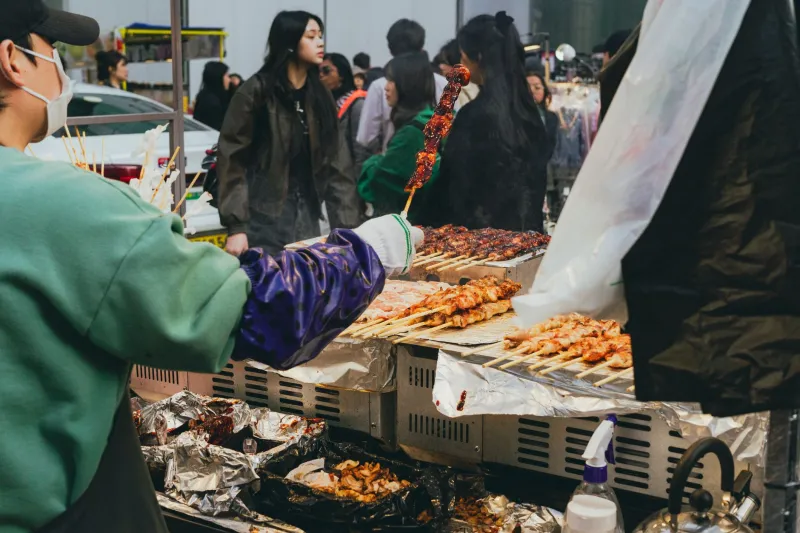
Night markets are not built for long meals. They are built for grazing. Find a stall with a free stool, order one thing, eat it, pay, and move on. Cash is still king at many stalls, so keep small bills handy. If a vendor waves you toward a shared table, take it. If you are standing at a counter, finish your bowl and step aside rather than treating the stool like a co-working desk. The whole point is turnover, and the system works because everyone plays along.
A Short Ordering Script That Won't Get You a Blank Stare
You do not need fluent Mandarin to eat alone well. You need about four phrases and the willingness to point.
- One person: say '一位' (yee way) and hold up one finger.
- Dine in: say '內用' (nay-yong) if someone asks whether you are staying or taking away.
- This one: say '這個' (jeh-guh) while pointing at the menu or at someone else's bowl.
- Takeout: say '外帶' (why-dye) if you want to eat somewhere else.
That is most of it. If you are at a counter with no host stand, do not wait to be seated. Find an empty stool, make eye contact with the person working, and sit down. If there is a line, join it. If you are paying with an EasyCard, have it ready. Tipping is not expected, and you will not be chased down if you leave a few coins on the counter.
When You'll Actually Share a Table
At busy noodle shops and night-market stalls, you may be waved toward a table that already has people at it. This is normal. Slide in, nod, eat. You are not interrupting a business meeting. You are participating in the efficient use of a small room. If you want more space, eat off-peak: late morning or mid-afternoon. The dinner rush from about 6:30 to 8 p.m. is when solo diners get folded into whatever seat is open. That is not a rejection. It is just Taipei doing the math.
Three Neighborhoods Where Eating Alone Is the Default
Zhongshan is the easiest place to start. Department-store basements, counter ramen, solo hot pot, and small coffee shops all assume you might be by yourself. It is a good neighborhood for a first solo dinner because you can walk five minutes in any direction and find another option.
Dadaocheng is better earlier in the day. Old noodle shops, rice-ball stalls, and tea houses around the alleys near Dihua Street are built for quick, quiet meals. Sit at a counter, watch the street, and order whatever the person beside you is having.
Gongguan feels like a student neighborhood, because it is. Small tables, cheap eats, and a steady stream of people eating alone between classes or errands make it one of the least self-conscious places in the city to sit down with a bowl and your own thoughts.
The One Etiquette Rule That Matters
Do not camp at a tiny counter during the lunch rush. Eat, pay, and go. Outside those peak windows, Taipei is remarkably relaxed about solo diners. No one will rush you out of a noodle shop at 3 p.m. No one will ask why you are eating hot pot by yourself on a Wednesday. The city has already decided that your seat is a legitimate seat. All you have to do is take it.